
We all know the importance of empowering people with their data. And the benefits that come from that. That’s why we support the MyData organisation, declaration and principles.
We also know how tough that can be in the face of business models that see personal data as raw material to be ingested and monetised. And then the related consent check-boxes and cookie banners that we see so many times a day – designed to be accepted with no ability to question, and very low expectation of enforcement.
But help is at hand. On Jan 28th 2026 (Data Privacy Day), a new global privacy standard launches through IEEE. Its formal name is IEEE P7012; its market-facing name is MyTerms. Just as IEEE 802.11 is the formal name for what we all now know and love as ‘WiFi’.
And MyData Global is part of the launch and ‘go to market’ team.
So what is this standard about?
Unlike possibly any other standard, IEEE P7012 is ultimately about manners, social norms and building a new social contract about online privacy. It sets out how to create digital norms around privacy as robust and respectful as we have in the physical world (IRL).
…. and what does it enable?
It enables individuals to signal their privacy preferences by selecting from a small number of standardised, easy-to-understand, legally valid agreements written from the individual perspective; and to share these with organisations they are engaging with online.
Then, in turn, it enables organisations to accept these proposals, or to propose an alternative from the same list. Or indeed they can reject or fail to acknowledge the signal; and have that recorded as such.
And what then is in the agreements themselves?
The default agreement for any individual proposing ‘MyTerms’ to an organisation is ‘Service Delivery Only’. Simplistically, that means the individual is saying ‘yes, of course I’ll give you the data you need and allow the uses of it that you need to provide your service to me; but I’m not allowing any more than that’.
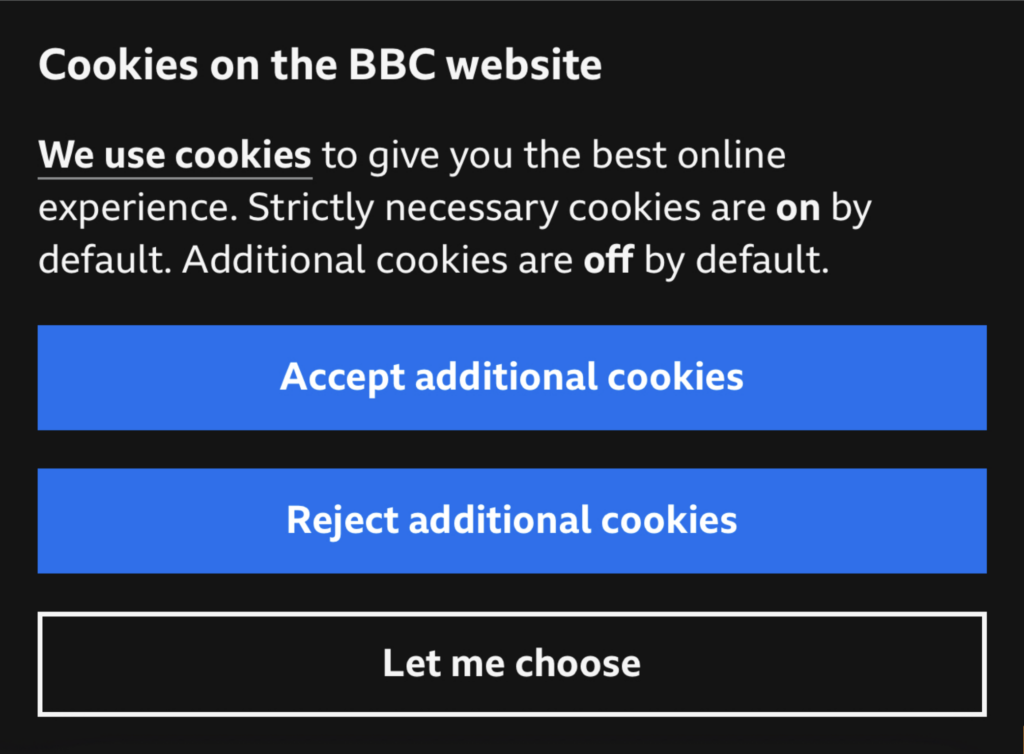
There are clearly many nuances to that in the ‘go live’ scenario; but this model is deliberately the equivalent of what we now see anyway – but better. Consider the visual below from the BBC News viewed inside the UK. MyTerms is the direct equivalent of ‘Strictly Necessary Only’. And when delivered as the initial call from a device to a web server to ‘send me your content’, then that privacy preference is expressed BEFORE the organisation needs to or can serve up a cookie banner or consent checkbox.
‘Can MyTerms help me get rid of cookie banners?’ was the number one request through the standards development process.
There are then four further agreements available at launch. One optimised for data portability, one for AI training and deployment, one for Data for Good projects, and one for sharing Intent data. Each is described in more detail on the MyTerms website.
MyData Global supported this standard development in its final phases in a workshop and feedback at the annual conference. And agreed to be the first organisation to do a deep dive on the MyTerms agreements and their use in practice from that organisational perspective.
The public launch of the MyTerms standard takes place in London and online on Wednesday, 28th January 2026 – Data Privacy Day. Sign-up links are provided below, and all MyData members are welcome to join.
Online / Webinar Event
https://mytermswebinar.eventbrite.com
London
https://mytermslondon.eventbrite.com
More details on the standard itself can also be found at the MyTerms website.
Post-launch, MyData Global and Customer Commons are forming The MyTerms Alliance; the industry association and partner programme that will be the channel for products and services built to the MyTerms standard. That will include a trust mark through which organisations can embed MyTerms in their processes and policies.
More details on how individuals and organisations can engage with MyTerms will emerge once we get beyond the launch.